Monday, 13 June 2016

Carbon dioxide caught in stone

Carbon dioxide is one of the main causes of climate change. Researches from Iceland have found a new way to story this gas so it can’t harm the climate; by turning it into rock.

Turning the earth into a greenhouse
Carbon dioxide creates, together with other gasses like methane and water vapour, an isolating layer around the earth. The layer of gas lets the sunlight through when it comes to the earth, but when it bounces of the earth again, it reflects the light back to the surface. In the same way as a greenhouse keeps the plants inside it warm, and that’s way this effect of reflecting back the sunlight is also called the greenhouse effect. But the greenhouse effect is definitely not all bad. Without this isolating layer around the earth, the average temperature on earth would be a cold -18 degrees Celsius, compared to the comfortable 15 degrees Celsius that we have with the greenhouse effect. Because all the water on earth would freeze at -18 degrees Celsius, life would not exist. The effect is, however, getting a little bit out of hand, which can cause more droughts, a rising sea level and more flooding, but also more extreme weather and less ice and snow. This is harmful for all life on earth.

Set in stone
Still liquid basaltic rock
But Juerg Matter and his team have found a way to store the excess carbon dioxide, so it doesn’t end up in the atmosphere. They have injected the carbon dioxide that a local factory in Iceland formed into large pieces of basaltic rock, a black, volcanic kind of stone. And 95 percent of the injected carbon dioxide stayed inside the rock. But that’s not all, scientists experimented with store the greenhouse gas in rocks before, but they always used sandstone, which acts a little like a sponge. When you inject the carbon dioxide into it, it stays there, but when the rock breaks, the carbon dioxide is released into the atmosphere again, because the little holes in the stone, that contained the gas, are now exposed to the open air. But with basaltic rock, it’s completely different. The carbon dioxide actually froms chemical bonds with the rock, making it almost impossible for the gas to escape. This method is therefore way more durable.

Good news for Spain and the US
This new method is particulary useful for countries that have a lot of basaltic rock in their soil, like Spain and the United States. They should be able to store most carbon dioxide that they produce in the rocks, because this new method, which is relatively simple, can be used on a larger scale too. Countries that don’t have much basalt in their soil could store their carbon dioxide in basaltic rocks somewhere else, but the CO2 that would produce, will easily outweigh the advantages of storing the greenhouse gas in the rocks. So they have to find other methods of dealing with their CO2.

Click here to read more geography posts.
Click here to read more chemistry posts.

Sources:

Wednesday, 8 June 2016

Seeing through chips

Rayko Ivanov Stantchev and his team have found a way to look inside computer chips. With terahertz radiation, they are able to look through materials that are otherwise opaque.

Light, but not quite
Terahertz radiation is part of the electromagnetic spectrum. This spectrum also contains radio waves, ultraviolet rays and also visible light. All types of radiation are sorted by wavelength on the spectrum. Terahertz’s wavelength comes right between microwaves and infrared, making its wavelength slightly longer than that of light. This is excellent for looking through materials, because the longer the wave, the bigger the objects the wave can ‘see through’. That’s why your computer has no problem with seeing the WI-FI (that are in fact radio waves), that comes from your router, but you can’t see the router, if you’re not sitting next to it. Radio waves have a way longer wavelength, and thus they can ‘bend’ around your furniture, stairs and cat. While the visible light, that your eyes see, has a shorter wavelength and can’t bend around your cat. But in the ability of waves to bend around things also lays the problem. You don’t want the waves to bend around the thing that you actually want to see. Terahertz waves have just the right wavelength

The electromagnetic spectrum, terahertz radiation comes between microwaves and infrared
Looking straight through
With terahertz radiation, we can look through computer chips, while still being able to see the structures inside it. To be able to look inside the chip, Rayko Ivanov Stantchev and his team beamed patterns of radiation onto a slice of silicon, the material most computer chips are made out of, that was only a hundredth of a centimetre thick. Because of this pattern, the silicon become transparent for the terahertz radiation. But the structures inside the chip don’t become transparent, enabling the scientists to see them. With this technique, they were able to find malfunctioning parts in the chip as small as eight micrometres across. That’s about half as thick as the finest human hair.

Image made with terahertz radiation,
 you can clearly see the structure
Computers and biology
The researchers consider using terahertz radiation a technique with much potential. For now, the possibility to see through silicon is limited by the thickness of the material, and the material can’t be really thick yet. Scientist predict that with improving the techniques, much thicker materials could be used. This can be really helpful with checking computer chips for malfunctioning parts, since the chips can just be ‘scanned’. But terahertz radiation has another interesting use. It could also be used in biology to scan tissues, because water, which is abundant in all living organisms, absorbs the terahertz radiation, making it easy to detect were there’s a lot of water. Because the radiation doesn’t bounce off of those spots. All in all a very promising technique that will benefit both computer sciences and biology.

Click here to read more about physics.

Sources:

Sunday, 5 June 2016

Sneak peek into Jupiter

‘We use Earth-bound radio observations to peer beneath Jupiter’s surface.’ says Imke de Pater in this week’s issue of Science. With radio waves, she and her team managed to see what goes on under Jupiter’s surface.

Mixed signals
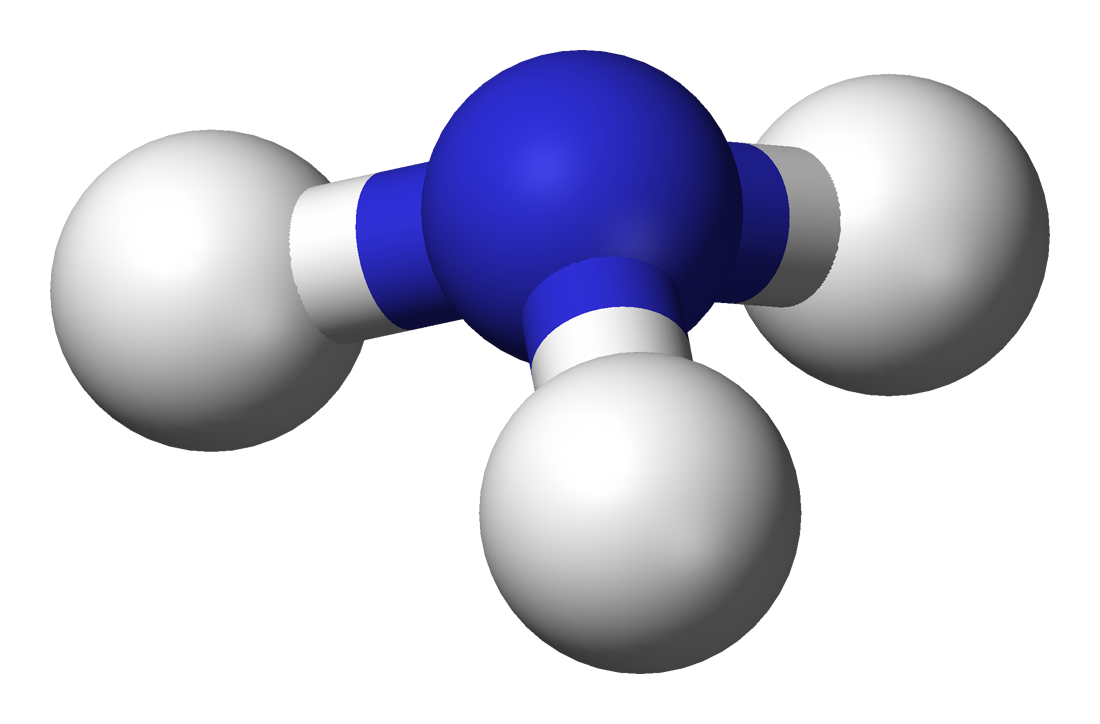
An ammonia molecule
The scientists were able to see as deep as a hundred kilometres beneath the surface. They have discovered lots of ammonia. The ammonia has confused scientists for quite a while. When spacecraft Galileo dropped a probe into Jupiter’s clouds in 1995, the probe already discovered really high concentrations of ammonia. This was quite strange, since the VLA radio telescope in New Mexico never managed to find such high concentrations of ammonia. This made scientists think that Jupiter’s atmosphere must consist of two layers; one with high concentrations of ammonia, and one with low. That were sometimes mixed up a bit by thunderstorms. Recent studies with an improved version of the VLA radio telescope show that there’s no need for two layers in the atmosphere, and that Galileo’s space probe just dived into a strange part of the atmosphere.

The radio wave picture (top one) shows
 the movements of ammonia in Jupiter’s atmosphere, 
the bottom picture is a normal picture taken by Hubble.
Simplifying the stripes
The new version of the VLA radio telescope has discovered stripes in Jupiter’s atmosphere, close to its equator. These stripes have alternating high and low concentrations of ammonia. And the high concentrations are caused by plumes of ammonia that rise from deeper inside Jupiter. This discovery enabled Imke de Pater and her team to fit both the high and low concentrations of ammonia into the same pattern. This pattern gives us a more detailed understanding of what’s going on around a hundred kilometres deep in Jupiter’s atmosphere. And also of the processes that happen much deeper in the atmosphere, since the patterns higher up are influenced by the processes lower in the atmosphere. Like when you see the fiftieth domino in a line of dominoes fall, you know that the first one also has fallen.

Husband and wife
This knowledge is also helpful for a new mission to Jupiter. Next month, space probe Juno is going to arrive by Jupiter. It is going to orbit around Jupiter and researching its gravity field, magnetic field and also concentrations of water and ammonia. With researching the water concentrations on Jupiter, scientist hope to find out more about Jupiter’s origin. And the new explanation of ammonia concentrations can be tested by Juno. This space probe can also peek deeper into Jupiter, because it’s way closer.

Click here if you want to read more about astronomy.

Sources: