Showing posts with label Physics. Show all posts

Thursday, 26 October 2017

Neutron Star kilonova


A Dangerous Waltz


Over 130 million years ago, before dinosaurs existed, there were two neutron stars. These two neutron stars were in a dance, spinning around each other at high speed; they were getting closer and closer with every revolution until they finally collided and became one, about 130 million years ago.

What is a neutron star?


Neutron stars are born when the core of a massive star is compacted into a sphere with a diameter of about 12 km. The result is a highly dense star which spins on its own axis at extremely high speeds; the mass of a typical neutron star is about twice the mass of our own sun. Neutron stars are so dense that if you were to take a piece that was about the size of a sugar cube, it would weigh at least 1-billion tons (that’s the mass of Mt Everest).

The rapid spin of the star is due to the conservation of angular momentum; a good analogy for angular momentum is a figure skater. When figure skaters spin, they can spin with their arms out or with their arms near themselves. When they spin with their arms closer to their bodies, they decrease their radius of gyration. Since they keep the same momentum, their angular velocity increases to compensate. The same exact thing happens in stars. When the core of a star is compacted into such a small area, the radius of gyration decreases immensely, thereby leading the star’s angular velocity to compensate by increasing.
Image result for figure skater angular momentum


Gravitational whats?


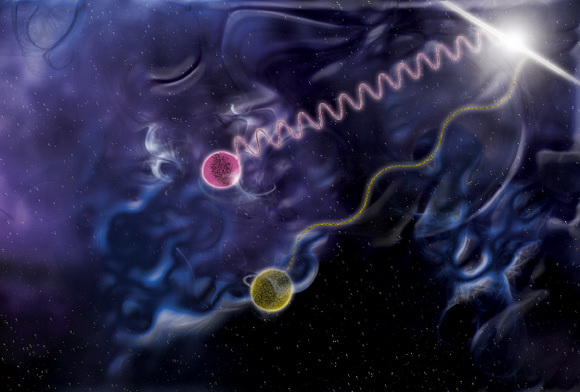
Gravitational waves are disturbances in the space time fabric that travel at the speed of light and are caused by the displacement of objects with mass. Warping of space-time is done by any massive object (object with mass). The only issue with finding evidence of this on earth is that significant warping requires immense mass. Since we can’t bring anything so massive to earth, we make do with what we can (i.e: the stars). In the video below, there is an animation of two massive bodies orbiting each other and losing energy as they go along until they eventually collide. We can see that, the faster they go, the more gravitational waves are created. This goes on until the two crash and release a deluge of gravitational waves.


Courtesy of NASA

Striking gold!

After the collision of these two neutron stars, they released a large amount of energy in a kilonova. This explosion released a tremendous amount of energy, and it also generated precious metals. When the two neutron stars collided, they released neutrons in their surroundings, effectively bombarding any nearby atoms and changing their chemical composition. Since elements created in the core of stars typically get no heavier than iron, this bombardment increases the mass of these atoms to make rare and precious metals.


http://svs.gsfc.nasa.gov//vis/a010000/a010500/a010543/WhtDwrfCollid_ProRes_720x486_59.94fps.webmhd.webm (VIDEO)

If you want to read more about astronomy, click here.
Click here to read more about physics

Saturday, 12 November 2016

Not only a new president; also new solar panels!

Solar cells will probably be one of the cornerstones of our civilisation in the near future. So scientists are continuously trying to improve the solar cells we have today. Their newest innovation are perovskite solar cells.

That’s way easier!
These new solar cells use inexpensive, commonly available materials. Which means that they are on their way to be used everywhere! On top of that, these new solar cells are just as good, or maybe even better than the solar cells we use today. Their secret is that they’re made of perovskite. Perovskite is a material that is mostly made of calcium-titanium crystals. And it is relatively easy to find calcium and titanium in the earth’s crust. Furthermore, Giles Eperon, Tomas Leijtens and Kevin Bush, the scientists that developed these new solar panels, could build the solar panels quite easily in their laboratorium. Something that is unthinkable with the solar panels we currently use, since they can only be manufactured at extremely high temperatures.
The alternating layers or perovskite
Combining the best traits
But the advantages don’t stop here yet. Perovskite solar panels are also thinner, more flexible, cheaper and better at capturing energy than the solar panels we currently use. Which are made of silicium, or basically just sand. Eperon and his team managed to achieve most of these advantages with just one trick. Instead of just using one layer of perovskite for their solar cell, they used two. And two layers with totally different abilities to be precise. The first layer can only absorb some specific types of light, but can then turn that into a super high electrical energy output. The second layer isn’t that picky and can absorb almost every type of light, but only puts out little electrical energy. By combining those two, the scientists got one super efficient solar cell.

There are some clouds...
But it’s not all sunshine with these new solar cells. Perovskite is known to degrade more quickly than silicon when exposed to moisture or light. But this problem mostly arises when the solar panels contain tin. And scientists have already found a way to work around this. They’ve designed perovskite solar panels that don’t contain any tin at all. So the only thing that the researchers have to do is perfect their design so that the solar panels can generate a maximum amount of electrical energy, and the solar panels are ready to roll.

Click here to read more about physics.

Sources:

Wednesday, 24 August 2016

Quantum bits times four

Quantum bits are the building blocks of Quantum computers because they represent two numbers at the same time. Scientists have now developed a quantum bit that represent four numbers simultaneously, instead of just two.

A simple picture of an atom
Fully controlled atom
Normal quantum bits basically consist of an electron (the really small particles that orbit atoms) trapped in certain kinds of material. This combination then starts to behave like an atom, but a very special one. We can control all the properties of this ‘artificial atom’. Normal atoms can have a few specific energy levels. These energy levels depend on the orbits of the electrons. The bigger the orbit, the higher the energy level. Since we can control all properties of ‘artificial atoms’, we can also control the energy level and keep it steady. With this advantage, we can focus on a really weird property of the atom; its spin.

Like a spinning top spinning both ways
You can imagine artificial atoms to be a bit like spinning-tops. They can either spin to the right or to the left. The artificial atoms can do the same. The quantum computer then calls a spin to the right zero and a spin to the left one for example. But if you don’t look at the atom, it can actually spin both ways at the same time, and thus the artificial atom can represent both a one and a zero. But as soon as you look at it, it’s suddenly either a one or a zero. This strange property enables quantum computers to run multiple calculations at once, while normal computers can only do one at a time. Really fast, that is, but still one at the time.

Graphene is weird
But now, scientists have discovered that we can really change the properties of an artificial atom by trapping it in graphene. Instead of two types of spin, it suddenly has four. The spinning top cannot only spin to the left and to the right, but also up and down. And you can now imagine it better as a ball. The quantum computer can call the two new spins two and three, and suddenly it has two whole new numbers to play with. This can make the quantum computer even faster, since it can do even more calculations in the sameamount of time.

The atoms are picky
But there is one problem though. For the artificial atoms to actually turn into balls instead of spinning-tops, and get four possible spins, they have to be trapped in a very smooth piece of graphene. If the graphene is a bit rough on the edges, the artificial atom will refuse to turn into a ball and just keep its two spins. And graphene is notoriously hard to make since it consists of a single layer of carbon atoms. So it’s incredibly thin and delicate. This makes it really unlikely that this new discovery will be used in some new invention any time soon, since further research has to be done to make these special artificial atoms more stable.


Click here to read more about physics

Sources:

Saturday, 20 August 2016

Bacteria don't only make you sick

The nanowire-making bacteria
Nanowires are the future of electronics. But they usually require nasty chemicals and difficult processes the create them. Scientists in Virginia have found a way to make bacteria form nanowires.

They’re everywhere

Nanowires are becoming more and more important parts in modern electronics. They can be found in transistors, which are important components of all devices that have chips in them; your computer, your phone, your television and even in your calculator. Nanowires also play an important role in some new innovations in solar panels. MIT scientists have designed solar panels that are both cheap and flexible, and they also use nanowires. These flexible solar panels could, for example, be used to cover the whole surface of electric cars so they could power themselves. However, the problem with nanowires is that they’re pretty hard to make.

Making nano-sculptures

There are basically two methods to make the small wires. The first one consists of obtaining large block of the material from which you want to make the wire (usually a metal such as copper), and cutting away all the excess. This technique can be likened a sculptor making a sculpture. The downside of this procedure is that nanowires are one billionth of a meter wide and mistakes are easily made. The other method is done by building up the wire from scratch.This is basically the complete opposite of the first one. This is similar to building with Lego. But when building a nanowire, the Lego bricks are fifty thousand times smaller than a human hair. So again, mistakes are easily made and this makes the creation of nanowires really difficult and expensive. But now, Yang Tan and his team have modified bacteria to make nanowires for them.

Make the bacteria do the work
The created nanowires (biowires)

They took some very common soil bacteria called Geobacter sulfurreducens. This bacteria can already make thin wires that are somewhat conductive. But with some advanced DNA modification, Yang Tan and his team implanted DNA from another bacteria into the geobacter. This new combination of DNA makes the bacteria form thinner and more conductive nanowires. This method is much easier than the older methods, since the only thing you need to do is keep the bacteria alive and wait. Another advantage of the nanowires made by bacteria is that they are really eco-friendly. Nanowires made with the older method usually have all kinds of toxic substances which can be very harmful for the environment. The bacteria-made nanowires don’t have these toxic substances in them, so it’s no problem if they end up in the environment. It might even be possible to just put your broken computer in the organic waste bin in the future.


Click here to read more about physics.
Click here to read more about biology.

Sources:

Tuesday, 16 August 2016

The LHC stays worryingly silent

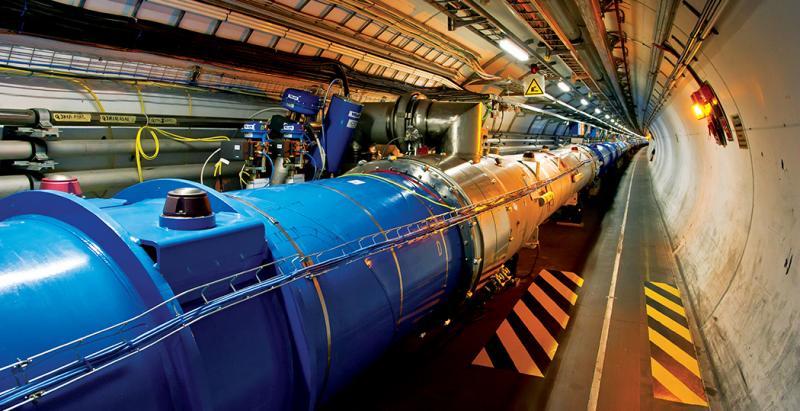
In 2012, the Large Hadron Collider discovered the Higgs-particle. Since then, the LHC hasn’t discovered any new particles, although it is working better than ever before. Scientists are worried.

Ehm…where are they?
At the LHC in Geneve, scientists make protons, one of the building blocks of atoms, collide which each other at very high speeds. And when you make things collide, they’ll break. Just like cars in a car crash. And when the cars break, you can see what’s inside of them. The LHC does pretty much the same thing. When the protons collide, we can see what’s inside of those too. With very advanced detectors, researchers can detect all kinds of fundamental particles that can teach us many new things about our universe. But the last major discovery was four years ago; the Higgs-particle. About a year after that, the LHC was closed for maintenance and an upgrade. Last year, the LHC was opened again, and now the particle accelerator works better than ever. It can accelerate the protons to higher speeds, which means bigger collisions. The researchers thought that would mean that they would discover more new particles. Except that they haven’t. And scientists are thinking there might not be any particles left to discover by the LHC anymore.

Protonic car crash times 400 trillion
After the upgrade, around 400 million-million protons have collided with each other in the LHC. And it hasn’t shown us any new particles yet. Scientists have a couple of explanations. The first one is of course quite simple; it’s an accident. We haven’t discovered a new particle, but the LHC can still find them and we just have to wait. “We could find something by the end of the year. You never know.” says Maria Spiropulu from CalTech. The second explanation is that the particles we’re looking for are actually way too heavy for the LHC to detect. Which means that the researchers working at the LHC will have to do very detailed measurements of the known particles, and from that they may be able to find clues those new, heavier particles. Whatever will be the case, the LHC will probably switch over to precision work, instead of the quite random proton-smashing that happens now, somewhere in 2018.

Don’t forget gravity
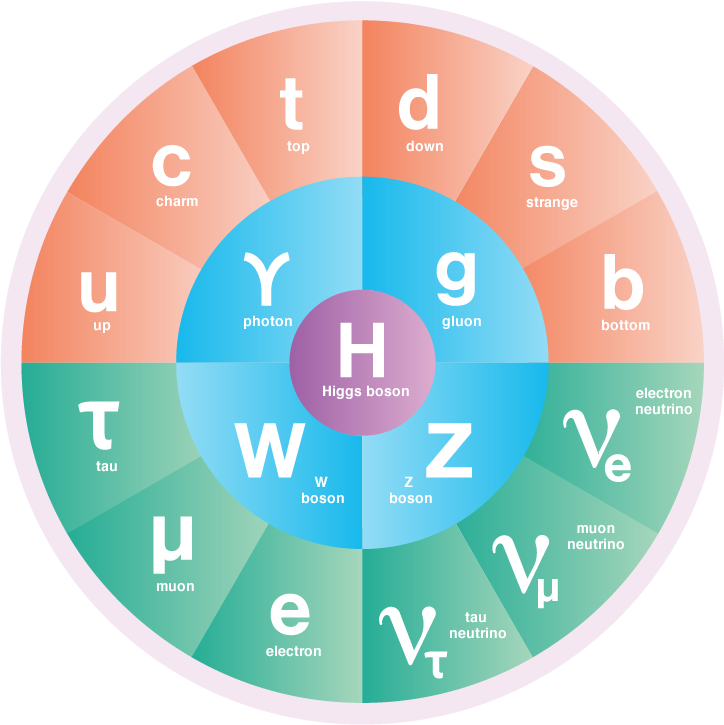
The Standard Model
The reason that scientists are convinced that there must be more particles, and that we don’t have just discovered all of them, is the Standard Model. In this model, we can fit all the particles, which can together explain all forces of nature. Except for gravity. So scientists are sure there must be one or more particles that are responsible for gravity out there. We just can’t find them. With even more improvements and upgrades to the LHC and its detectors, and with new precision measures of the well-known particles, we can find new clues to those hiding particles. Or maybe we just have to wait.

Click here to read more about physics.

Sources:

Wednesday, 27 July 2016

Finding the faintest light

We can’t see as well in the dark as, for example, cats can. But what’s the smallest amount of light we can still see? Jonathan Tinsley and his team found the answer.

The faintest light bulb
Tinsley and his team found out that we can actually register the tiniest amount of light possible; single photons. But what are photons? To answer this, we first have to take a look at light itself. Light is, quite simply, a form of energy. But there’s something strange about it; light cannot just have any amount of energy. The reason for this is that a light source, like a light bulb, can only emit whole photons (a photon is like a little packet with a specific amount of energy in it). In other words, if you had a light bulb connected to an extremely precise dimmer, you would only to able to add whole photons when you turn the light up and you would only be able to take away whole photons when you turn the light down. Because of this, if you were turn the dimmer all the way down, the light would either be off or emit just one photon at a time, there’s nothing in between. And now, it turns out we can actually see light with the lowest energy possible; just single photons.

Did you see it?
In the 1940s, scientists already found out that our eyes can detect very low amounts of photons; between five and seven. This is extremely little if you keep in mind that the average light bulb emits two hundred duodecillion photons (that’s a two with 41 zeros) per second. And now, seventy years later, Jonathan Tinsley and his team have discovered that we can register individual photons. The scientists discovered this with an experiment where they asked some test subjects to take part in a sort of game. When the people that participated in the experiment pressed a button, the machine either shot a photon or did not shoot one. The test subjects then had to say if they saw the photon and also how confident they were about whether they saw it or not. After a lot of button pushing, Jonathan Tinsley and his team found that the human guinea pigs were right fifty-two percent of the time. This means that did a little better than if they were just randomly guessing, which would result in getting it right fifty percent of the time. This two percent is, of course, not a significant difference. And that’s where the confidence comes in. The times when the test subjects were really confident about whether or not they saw a photon, they got it right sixty percent of the time. The reason for this is that the photons don’t always create a signal that your brain can actually register. So sometimes there were some photons that the test subjects couldn’t see, but sometimes they could. But what can we learn about our eyes from this?

It’s not perfect
Between light entering your eyes and your brain registering the signal created by that light, there are quite a lot of steps. With every step, a bit of the signal gets lost and a little bit of noise is added. This means that everything you see gets a bit blurred and muddied. Fortunately, it has such little influence on what you actually see that you rarely notice. And now, the photon experiment gives us some new knowledge about this blurring and mudding. We now know that this blurring effect is so small that even photons don’t get affected by this. The results of this experiment aren’t, however, completely watertight yet. The tests were only done on three people, which were all men in their twenties. Future experiments can tell us if women and people of other age groups can also see photons. These experiments will tell us even more about our eyes.

Click here to read more about biology.
Click here to read more about physics.

Sources:

Saturday, 23 July 2016

Taking a closer look at coral

When you want to take a look at something small, you use a microscope. But what if you want to observe something under water? You can’t use a normal microscope then. Andrew Mullen has a solution.

It’s pretty hard

There are a couple of problems you face when designing an underwater microscope. For starters, an air-filled tube, what a microscope essentially is, is going to float. So you have to attach something heavy to it so it sinks. There’s also the problem of getting the diver’s eye close enough to the microscope so he or she can look through it. Since the diver is wearing a diving mask, putting that against the microscope to try and take a look won’t work. The microscope also needs to be some distance away from the thing you want to observe otherwise, the microscope would damage it. And that’s not a thing you want if you’re studying delicate coral structures. Moreover, you also need some electricity to light up the thing you want to take a look at. However, this can be solved quite simply with a battery. A bigger problem emerges when you want to observe something in moving water. It’s very difficult then to keep the microscope still, and also not to float away yourself. Andrew Mullen and his team were able to tackle all these problems and design a good underwater microscope.


A solution to all your problems
Mullen’s microscope is completely adapted to work underwater. It is connected to a camera, so nobody has to look through it and have problems with their diving masks. But the microscope, which is called the Benthic Underwater Microscope (BUM), can also focus really quickly, so it can take quick, clear photos of the thing that’s being observed. This comes in handy in moving water, because moving the microscope around a bit isn’t a huge problem anymore. It also has LED-lights to shine light on the observed specimen. All the components sit snugly in a compact housing, so the microscope is very easy for a diver to work with. So easy that it can be operated by just one diver.

Magnify the coral!
consequences of bleached coral; dead coral

Andrew Mullen and his team use the microscope to take detailed pictures of coral. These structures are so delicate that it is impossible to take them out of the water and observe them on land. With the microscope, the scientists have found out how polyps, the little animals coral is composed of, digest their prey. They work together and digest it with combined movement of their tentacles. The microscope is also great for studying the bleaching of coral. This bleaching happens when algae that live on the coral die because of changes in the seawater, which are probably caused by climate change. The coral can’t live without the algae and dies too, leaving behind a ghost town of coral. So this new microscope will also come in really helpful in finding ways to protect the beautiful coral reefs.

Click here to read more about biology.
Click here to read more about phyics.

Sources:

Friday, 15 July 2016

Graphene acts like a poster

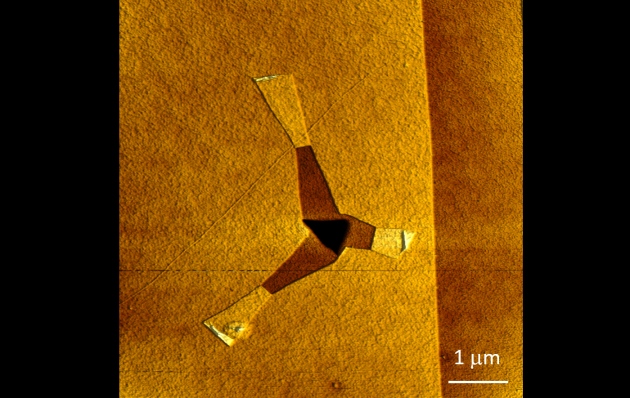
Graphene, the weird material that already has all kinds of odd and useful properties, has a new one; it can rip itself into ribbons. James Annett discovered this by accident.

Poking out a ribbon
Graphene is a material made out of carbon atoms, just like diamond, but also like graphite, the stuff that’s inside your pencil. But the carbon atoms are arranged in a special way. Graphene is a material that’s only one layer of atoms thick, and because of that, the atoms are arranged in a special pattern which gives graphene all kinds of special qualities. Just like diamond is really strong and transparent because of the way the carbon atoms are arranged inside of it and the graphite inside your pencil is really soft and black, graphene is extremely strong, about two hundred times stronger than steel, and it’s really good at conducting electricity. These things, combined with the fact that graphene is transparent, makes graphene a very useful material in among other, electronics. The screen of your smartphone has, for example, tiny copper wires woven into it. These copper wires could be replaced by wires made out of graphene, which would make your screen bendable, as graphene is really strong and could withstand the pressures of being bend way better than copper, which could easily break. But now, scientists have discovered a new property of graphene; it rips itself into ribbons when you poke a hole in it.

It wants to roll up
This odd property was discovered by two scientists in Dublin. James Annett was doing experiments on the friction characteristics of the material when he accidentally poked a couple of holes in the graphene sheet he was using. After that, he saw with a microscope that tiny ribbons had formed around the holes. Together with Graham Cross, he also found an explanation for the ribbon-forming; multiple layers of graphene are more stable than just the one layer. So if the graphene gets the chance, it rolls up like a poster that has spent too much time in his tube. The bindings that hold the carbon atoms together are very strong however. Because of this, you need to wiggle around a little in the hole in the graphene sheet to make the bindings looser, and longer ribbons form when the temperature is higher, since the binding are already looser when it’s hot.

Ribbons in your phone
Graham Cross also sees great ways to use this new property of graphene. He thinks the ribbons can be used in transistors, which are tiny switches controlled by electricity, and other electronics. But the problem is that it is quite difficult to influence how the ribbons form. This makes James Tour, an expert in nanotechnology, sceptical about the discovery. Boris Yakobson on the other hand, is thrilled by the new discovery, and he already has a plan on how to control the shape of the ribbons by poking even more holes in the graphene. So maybe you’ll have a bendable smartphone in your pocket in ten or twenty years, filled with graphene ribbons.

Click here to read more about physics.

Sources:

Thursday, 7 July 2016

Big asteroid created Fear and Panic

Mars has two moons; Phobos and Deimos. Now, Pascal Rosenblatt and his team think that the planet used to have way more moons, as they publish in this week’s Nature.

Fear and Panic; Phobos and Deimos
Scientists used to think that Phobos and Deimos, Mars’s moons, are two asteroids that got stuck in Mars’s gravity. This also made sense, since the asteroid belt is close to Mars. Moreover, the moons have an irregular shape and are not made of the same stuff as Mars. These are also clear signs that Phobos and Deimos originally were asteroids. There’s only one problem. When an asteroid gets caught in the gravity field of a planet, its orbit is usually elliptical, oval shaped. This is because the asteroid is shooting through a bit before being pulled back by the planet, this creates the oval shape. But, Phobos’s and Deimos’s orbits are circle shaped. And Mars’s gravity is way too weak to turn an oval orbit into a circular orbit. The chances that the circular orbits happened by accident are so small that it is more likely that Phobos and Deimos formed in another way, closer to Mars.

A big boom results in some moons
Pascal Rosenblatt and his team believe that Phobos and Deimos are formed out of debris that was formed when a giant asteroid hit Mars. That debris then formed a ring around Mars, and with computer simulations, Rosenblatt and his team found out that a couple of moons were formed out of that debris. All those moons, except two, orbited too close to Mars and crashed into the surface. The other two moons slowly moved into higher orbits and eventually became what we now know as Phobos and Deimos. We have, of course, no way to check this. Since we can’t just travel back in time and take a look. But if Phobos and Deimos are made out of a little bit of Mars and a bit of asteroid, it would pretty much prove this theory right.

The Borealis basin is the orange area on the left
Solving our puzzle
But there’s also another thing this new theory can explain. If an asteroid collided with Mars, there must be a crater. Rosenblatt and his team might even have found this crater already; the Borealis basin, a crater that covers around forty percent of the surface of Mars. The collision that created this crater must also have created a lot of debris, out of which the two moons and more could have easily formed. And at the same time, this new theory about Mars’s moons is another piece in the puzzle that is our solar system, and we might even be able to solve the complete puzzle one day.


Click here to read more about astronomy.
Click here to read more about physics.

Sources:

Wednesday, 8 June 2016

Seeing through chips

Rayko Ivanov Stantchev and his team have found a way to look inside computer chips. With terahertz radiation, they are able to look through materials that are otherwise opaque.

Light, but not quite
Terahertz radiation is part of the electromagnetic spectrum. This spectrum also contains radio waves, ultraviolet rays and also visible light. All types of radiation are sorted by wavelength on the spectrum. Terahertz’s wavelength comes right between microwaves and infrared, making its wavelength slightly longer than that of light. This is excellent for looking through materials, because the longer the wave, the bigger the objects the wave can ‘see through’. That’s why your computer has no problem with seeing the WI-FI (that are in fact radio waves), that comes from your router, but you can’t see the router, if you’re not sitting next to it. Radio waves have a way longer wavelength, and thus they can ‘bend’ around your furniture, stairs and cat. While the visible light, that your eyes see, has a shorter wavelength and can’t bend around your cat. But in the ability of waves to bend around things also lays the problem. You don’t want the waves to bend around the thing that you actually want to see. Terahertz waves have just the right wavelength

The electromagnetic spectrum, terahertz radiation comes between microwaves and infrared
Looking straight through
With terahertz radiation, we can look through computer chips, while still being able to see the structures inside it. To be able to look inside the chip, Rayko Ivanov Stantchev and his team beamed patterns of radiation onto a slice of silicon, the material most computer chips are made out of, that was only a hundredth of a centimetre thick. Because of this pattern, the silicon become transparent for the terahertz radiation. But the structures inside the chip don’t become transparent, enabling the scientists to see them. With this technique, they were able to find malfunctioning parts in the chip as small as eight micrometres across. That’s about half as thick as the finest human hair.

Image made with terahertz radiation,
 you can clearly see the structure
Computers and biology
The researchers consider using terahertz radiation a technique with much potential. For now, the possibility to see through silicon is limited by the thickness of the material, and the material can’t be really thick yet. Scientist predict that with improving the techniques, much thicker materials could be used. This can be really helpful with checking computer chips for malfunctioning parts, since the chips can just be ‘scanned’. But terahertz radiation has another interesting use. It could also be used in biology to scan tissues, because water, which is abundant in all living organisms, absorbs the terahertz radiation, making it easy to detect were there’s a lot of water. Because the radiation doesn’t bounce off of those spots. All in all a very promising technique that will benefit both computer sciences and biology.

Click here to read more about physics.

Sources: