Showing posts with label Astronomy. Show all posts

Thursday, 26 October 2017

Neutron Star kilonova


A Dangerous Waltz


Over 130 million years ago, before dinosaurs existed, there were two neutron stars. These two neutron stars were in a dance, spinning around each other at high speed; they were getting closer and closer with every revolution until they finally collided and became one, about 130 million years ago.

What is a neutron star?


Neutron stars are born when the core of a massive star is compacted into a sphere with a diameter of about 12 km. The result is a highly dense star which spins on its own axis at extremely high speeds; the mass of a typical neutron star is about twice the mass of our own sun. Neutron stars are so dense that if you were to take a piece that was about the size of a sugar cube, it would weigh at least 1-billion tons (that’s the mass of Mt Everest).

The rapid spin of the star is due to the conservation of angular momentum; a good analogy for angular momentum is a figure skater. When figure skaters spin, they can spin with their arms out or with their arms near themselves. When they spin with their arms closer to their bodies, they decrease their radius of gyration. Since they keep the same momentum, their angular velocity increases to compensate. The same exact thing happens in stars. When the core of a star is compacted into such a small area, the radius of gyration decreases immensely, thereby leading the star’s angular velocity to compensate by increasing.
Image result for figure skater angular momentum


Gravitational whats?


Gravitational waves are disturbances in the space time fabric that travel at the speed of light and are caused by the displacement of objects with mass. Warping of space-time is done by any massive object (object with mass). The only issue with finding evidence of this on earth is that significant warping requires immense mass. Since we can’t bring anything so massive to earth, we make do with what we can (i.e: the stars). In the video below, there is an animation of two massive bodies orbiting each other and losing energy as they go along until they eventually collide. We can see that, the faster they go, the more gravitational waves are created. This goes on until the two crash and release a deluge of gravitational waves.


Courtesy of NASA

Striking gold!

After the collision of these two neutron stars, they released a large amount of energy in a kilonova. This explosion released a tremendous amount of energy, and it also generated precious metals. When the two neutron stars collided, they released neutrons in their surroundings, effectively bombarding any nearby atoms and changing their chemical composition. Since elements created in the core of stars typically get no heavier than iron, this bombardment increases the mass of these atoms to make rare and precious metals.


http://svs.gsfc.nasa.gov//vis/a010000/a010500/a010543/WhtDwrfCollid_ProRes_720x486_59.94fps.webmhd.webm (VIDEO)

If you want to read more about astronomy, click here.
Click here to read more about physics

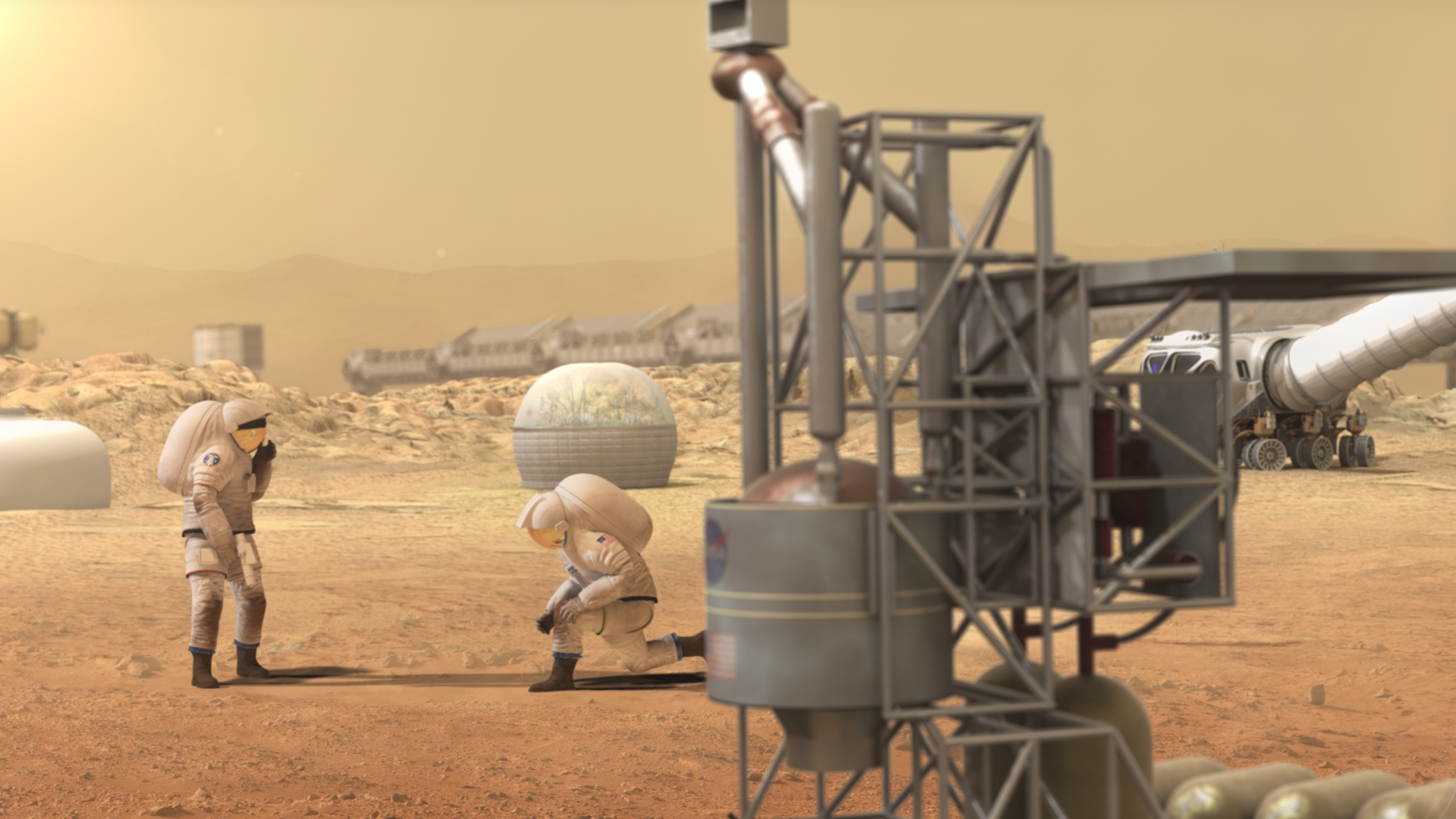
DIY fuel for Martian astronauts


Plans for a manned mission to Mars are on the news just about every other day. But for now, such a manned mission seems impossible. However, Portuguese scientists have brought us one step closer taking people to Mars.


Houston, my rocket is too heavy
One of the main problems when travelling to Mars, and for space travel in general, is fuel. Of course, fuel is absolutely necessary to travel around in space, but it’s also extremely heavy. For example, the fuel that the space shuttle needed was almost 20 times as heavy as the space shuttle itself. And the space shuttles always stayed relatively close to earth. Imagine the fuel a spacecraft flying to Mars, landing there, launching again, and travelling back to earth would need. It’s impossible to build such a rocket, let alone launch it. Because of this, space engineers thought for a long time that it would be impossible to have people return from Mars, making a trip to Mars a lifelong mission. But now, Vasco Gama and his team at the university of Lisbon have made an interesting discovery that could change this.


Don't bring it, make it!
This discovery has everything to do with the atmosphere of Mars. Martian air contains roughly the same stuff; oxygen, carbon dioxide, nitrogen, as the earth’s atmosphere. The only difference is that the proportions are vastly different. Mars’s atmosphere consists of over 95 percent carbon dioxide, while on earth, that’s just 0,04 percent. Gama and his team have come up with a clever technique to make that high percentage of carbon dioxide on Mars useful. They have found a way to turn carbon dioxide into oxygen and carbon monoxide using a special substance called a plasma. The oxygen can of course be breathed by the astronauts staying on Mars, but it can also be used as rocket fuel, in combination with carbon monoxide. This means that the astronauts can make fuel for their rocket while they are on Mars, so they don’t need to bring it along with them. With this new technique, we can go to Mars with lighter and thus safer rockets, bringing the chances of a manned mission to Mars one step closer.

Earth can tag along as well
But that’s not everything. On earth, we’re currently facing a great problem in the shape of global warming. This is caused by carbon dioxide emissions, which have greatly raised the amount of carbon dioxide in the air. With this plasma technique discovered by Gama and his team, we might be able to change some of our ‘own’ carbon dioxide into oxygen. However, there are some challenges when it comes to this. For example, the amount of carbon dioxide on earth is way lower than the amount on Mars, making it harder to ‘find’ the molecules in the air. More research has to be done to make this new technique properly useful on both earth and Mars, but the first step has been taken.

Sources:

If you want to read more about astronomy, click here.

Monday, 21 November 2016

Pluto got tipped over by its ice cap


Pluto is an extremely cold planet with quite a lot of ice. So much so that New Horizons discovered that it even tilted Pluto to its side.


That’s a whole lot of ice
A few months ago, space probe New Horizons flew past Pluto. The advanced equipment it has on board includes a device that detects solarwinds, an ultraviolet detector, and a multitude of cameras and telescopes. These cameras have already taken extremely detailed pictures of Pluto, revealing things about the dwarf planet that we had no idea about previously. For example, we now know that our previous information about Pluto’s size was inaccurate; it is a bit bigger than we thought, but unfortunately still not big enough to be classified as a planet. New Horizons also discovered that a large part of Pluto is covered by a tear-shaped ice cap which is so big and so heavy that scientists think that it has actually caused the dwarf planet’s tilt.

There goes your frisbee
Pluto’s rotational axis is tilted about 60 degrees. Previously, scientists had no idea what the reason was. Now, James Keane and his team think it has something to do with the enormous ice cap, Sputnik Planitia. They think that the ice cap is so heavy that it has actually tipped over the dwarf planet a little. Imagine Pluto as a frisbee and the ice cap as a small weight stuck to one side of the frisbee. If you throw the frisbee, it will tilt to the side because of the weight; the same thing has happened to Pluto.


The imaginary bar is shown in re

Hey moon!
But there’s something else that’s a bit odd about the icecap that has to do with Pluto’s moon. Pluto and its biggest moon, Charon, are always facing each other with the same side. So a Plutonian would only ever see one side of Charon and a creature living on Charon would only see one side of Pluto. Pluto and Charon seem to be connected to each other by an imaginary bar. The ice cap however, is located exactly opposite to the side that’s facing Charon. So our Charon-creature would never see the icecap. And this is exactly one of the places where a heavy weight like the ice cap could be located without tilting the dwarf planet further. If you imagine the frisbee with the weight again, but now, you stick the weight exactly in the center of the frisbee. Then it won’t tilt to the side anymore when you throw it. The same is true for the location of the ice cap on Pluto, because Charon keeps the dwarf planet in check.

Satellites are expensive
But the problem is, we can only guess how heavy the icecap is. And how it actually influences Pluto’s gravity. To study this more closely, we need a satellite orbiting around Pluto. This satellite could then study closely how Pluto’s gravity field behaves, and if the ice cap actually has any effect on it. This won’t happen anytime soon however, since it’s incredibly difficult and expensive to get a satellite in orbit around such a distant dwarf planet. But for now, it’s a good explanation for Pluto’s tipped axis and the location of Sputnik Planitia.

Click here to read more about astronomy.

Sources:
https://cdn.instructables.com/FCF/C3BB/HIYWUAXK/FCFC3BBHIYWUAXK.MEDIUM.jpg

Sunday, 18 September 2016

Gaia is mapping the stars

Spacecraft Gaia is going to map our entire galaxy. And with all that data, NASA scientists hope to compose a five-dimensional map of our galaxy, and discover the Milky Way’s past.

spacecraft Gaia
Where are the stars?
Three years ago, spacecraft Gaia was launched. Then the spacecraft, which basically is a giant telescope floating in space, needed the past three years to put together a draft of a map of our galaxy. The reason it took Gaia so long to only turn out a draft is that the spacecraft has already catalogued more than a billion stars for this draft. This is of course an incredible amount, but Gaia isn’t done yet. Our galaxy consists of over 200 billion stars, so the telescope has only catalogued half a percent of all stars. Gaia is going to further map our galaxy for at least another two years. In these five years, Gaia isn’t going to be able to map the other 199 billion stars, instead Gaia is going to focus on refining the data about the billion stars that the spacecraft already mapped.

Gaia's map so far
A look into the future and the past
Gaia has already mapped the position and brightness of over a billion stars, and also the distance and speed of the two million brightest stars. In the next two years, NASA scientists, who control the spacecraft, want to find the distance and speed of way more stars. They’re hoping for a billion. But that’s not all, they also want to map the speeds of the 100 million brightest stars in 3D. While the speeds of the other, dimmer stars are only in 2D, so only sideways. These data will enable scientists to create a five-dimensional model of our galaxy, and essentially predict the Milky Way’s past and future. This could teach us a whole lot about the Milky Way’s possibly violent past, as there are indications that the Milky Way has absorbed quite a lot of smaller galaxies in the past. Which would have caused violent collisions of which we still can see traces today.

Better than the ocean floors
This galaxy-map will also help scientists understand the birth of stars better. Because with the data that will be gathered by Gaia, scientists can calculate the size and also the age of stars, which are essential for finding out how stars actually form. Another thing is that our own Milky Way is a bit like the earth’s ocean floor compared to the moon. We’ve got a better grasp of what’s happening on the moon than on what’s happening on the ocean floor. In a similar way, we know more about some other galaxies than about our own home. That is mainly because the Milky Way is so big, and we’re right in it so we can’t really take overview pictures of it. This makes getting a good, complete view of the Milky Way really hard, but Gaia is changing that. Within a few years, we’ll have the most detailed map of our galaxy yet. And we will, no doubt, have learned all new kinds of cool and interesting things about our own galaxy, thanks to Gaia.

Click here to read more about astronomy.

Sources:
https://www.scientias.nl/miljard-sterren-elkaar-ziet-er-zo/
http://www.cosmos.esa.int/web/gaia/home
http://www.scientificamerican.com/article/upcoming-galaxy-map-could-radically-transform-how-we-see-the-milky-way/
http://blogs.esa.int/gaia/files/2013/07/Gaia_mapping_the_stars_of_the_Milky_Way.jpg
https://cbssanfran.files.wordpress.com/2016/09/gaia_gdr1_sky_map_annotated_hd.png

Wednesday, 7 September 2016

Dawn on almost three dwarf-planets

In 2007, space probe Dawn was launched. And now, nine years later the probe has reached its final destination; Ceres. It has already discovered some strange, exciting things.

Is it salt or water?
When Dawn started orbiting Ceres in 2015, it found strange, white spots on the dwarf-planet’s surface. Unfortunately, Ceres’ cameras couldn’t take pictures that were detailed enough for us to see what those white spots were. The NASA scientists that control the space probe then managed to get Dawn into a lower orbit around dwarf-planet Ceres. In this lower orbit, Dawn can observe the white spots more closely. Scientists discovered that the white spots are all the bottoms of craters. This made them think that the spots are either made of salt or ice. The space probe couldn't get close enough to the dwarf-planet to find out which one it is. If the white spots are ice, this means that the dwarf-planet has at least one requirement for life; water. However it’s unlikely that we’ll find aliens there, since the big rock is way too cold. And on top of that, the dwarf-planet doesn’t have an atmosphere. But Ceres isn’t the only dwarf planet space probe Dawn visited.

Two for one!
Space probe Dawn already orbited another dwarf planet called Vesta between in 2011 and 2012. This makes Dawn the only space probe that has orbited a celestial body, studied it and travelled further to orbit and study a second celestial object. The two Voyager space probes also studied multiple celestial bodies; the gas giants of our solar system, but they never orbited them. On Vesta there were dark spots that sparked the interest of scientists. Fortunately, Dawn could zoom in enough onto those dark spots to tell what they are; craters. Craters may not sound as interesting as water and possible - though highly unlikely - alien life. Those craters can tells us something else though; we can discover a lot about what happened during Vesta’s life, and what it was like in our solar system billions of years ago. Dwarf-planets are a bit like time-capsules in this way.

Philae on its comet
Orbiting forever
If we want to learn more about the history of our solar system, the main thing we have to do is study asteroids better. This is also the reason that space probe Rosetta and comet lander Philae were launched. Those probes closely studied comet 67P/Churyumov-Gerasimenko, and even discovered the building blocks of life there. Space probe Dawn, however, isn’t going to orbit another asteroid. NASA scientists had proposed plans about sending Dawn to another asteroid, but this was cancelled. The scientists leading Dawn’s mission think that staying in orbit around Vesta can give us way more scientific data than a quick visit to another asteroid. So it was decided that Dawn will stay in Vesta’s orbit forever, and gather data until at least 2017.

Click here to read more about astronomy.

Sources:
http://blogs-images.forbes.com/bridaineparnell/files/2015/06/Philae_touchdown-1940x1092.jpg

Thursday, 1 September 2016

Dragonfly 44: the darkest galaxy yet

Astronomers have found a really small galaxy, which has one weird trait. It spins a lot faster than it should. Pieter van Dokkum and his team think dark matter is the explanation.

A dark dragon
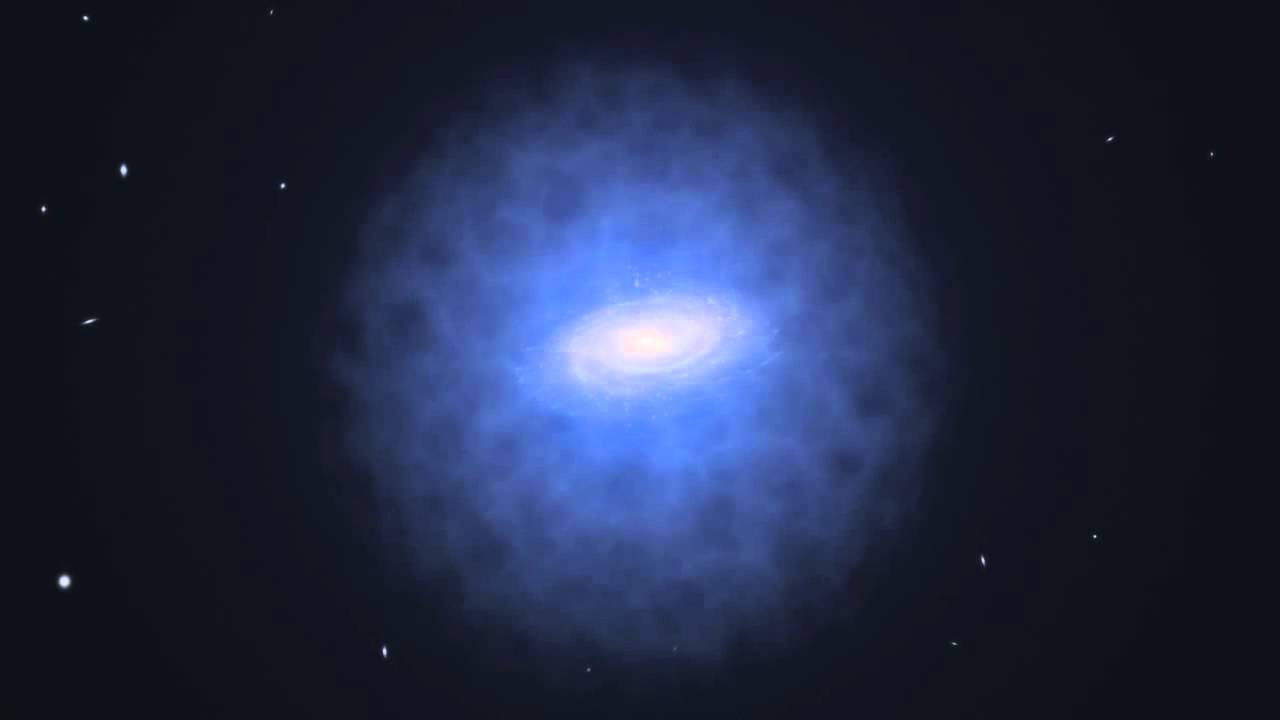
The yellow smudge in the middle is Dragonfly 44

The galaxy measures around 60 000 light-years across, and is about 300 million light years away. It weighs almost the same as the Milky Way, but has nowhere near the amount of stars. Dragonfly 44 consist of about two billion stars, while our galaxy has over two-hundred billion stars. What is really strange is that the Milky Way and Dragonfly 44 appear to have roughly the same mass; both the Milky Way and Dragonfly weigh about as much as a trillion suns. This means 99 percent of the Dragonfly galaxy must consist of matter we can’t observe. A team of American and Canadian scientists think that a lot of dark matter is hiding in Dragonfly 44. It was discovered last year in the Coma galaxy cluster along with other similar galaxies, which the team combined and named Ultra Diffuse Galaxies (UDGs). Dragonfly 44 is the largest out of all of them.

What dark matter would look like if we could see it
We can’t see it, so it’s dark
What exactly is dark matter? Well, the truth is that we don’t really know. What we do know is that more than a quarter of the mass of the whole universe is dark matter. Overall, dark matter leaves scientists completely puzzled. The reason that it’s such a mystery is that dark matter doesn’t interact with light. That’s why it’s called dark matter - we can’t see it. We can only say it exists at all through the effects it has on its surroundings. One way we notice dark matter is in galaxies that appear to have more mass than their amount of stars can explain. An extreme case is Dragonfly 44, but our own galaxy also has quite a big mass-star misalignment. Scientists think that around 90 percent of all the matter in our galaxy is dark matter. This also means that everything you can see, your house; your food; the sun; and everything else is just a tenth of all the matter in our galaxy.

You’re spinning too fast!
If the hypothesis that Dragonfly 44 is made almost completely out of dark matter, it would explain some mysterious things about the galaxy. First of all, it spins way faster than it should. The general rule is the bigger the mass, the faster a galaxy spins. This is because more mass creates more gravitational force, which speeds up the spinning of the galaxy. If all the mass of Dragonfly 44 consisted of normal matter, stars that we can actually see, the galaxy would never reach such a fast spin. On top of that, even if it would, the galaxy would most likely tear itself apart. If the mass is low, the gravitational forces would be too weak to keep such a fast spinning galaxy together if there weren’t any dark matter around. Scientists also consider this discovery to be particularly interesting since galaxies that are almost completely made of dark matter have already been predicted by some theories, and this new discovery only helps those theories to become even more likely. 


Click here to read more about astronomy.

Sources:
http://arxiv.org/pdf/1606.06291v2.pdf
http://www.sciencemag.org/news/2016/07/dark-matter-search-comes-empty
http://www.sciencemag.org/news/2016/08/dim-nearby-galaxy-nearly-100-dark-matter
https://nl.wikipedia.org/wiki/Melkweg_(sterrenstelsel)
http://cdn.sci-news.com/images/enlarge3/image_4135e-Dragonfly-44.jpg
https://i.ytimg.com/vi/PznhzHOtr_Y/maxresdefault.jpg

Thursday, 4 August 2016

Salty oxygen surprises scientists

Studying how the atmosphere was millions of years ago can tell us a lot about early life on earth. But that air is long gone. Nigel Blamey and his team have found a salty solution.

Air tight enclosed in salt
Blamey and his team have closely analysed ancient salt crystals. Salt crystals have tiny pockets of air in them and Blamey managed to extract these pockets out of the crystals in order to analyse them. They drilled up 815-million-year-old salt crystals from Australia’s soil and with a special device, they were able to crush the crystals and then capture the old gases that come out of the crystals. They then analysed those gases and made a really interesting discovery.

That’s weird…
Blamey and his team discovered that 815 million years ago, there was twice as much oxygen in the air as we used to think. Scientists used to think that there was only around 5 percent oxygen in the atmosphere that long ago. They also used to think that it was the reason for the lack of any complex life back then. The first complex life arose between 100 and 200 million years later, in a period called the Cambrian explosion. This explosion of complex life marked the beginning of the geological period called the Cambrian. During the Cambrian explosion all major ‘branches’ of the tree of life evolved. For a long time, scientists thought that complex life was made possible by the sudden increase of oxygen in the atmosphere. But now, Nigel Blamey and his team have discovered that the oxygen levels were already high enough for such an explosion millions of years earlier. So the Cambrian explosion must have had another reason.

No idea
Well, scientists haven’t found a reason yet. This discovery is so recent that scientists haven’t been able to adapt their theories yet. But Blamey and his team have found other interesting uses for their new machine that can extract gases from ancient salt crystals. For starters, they can analyse different salt crystals from other time periods. Through this, we can learn more about the history of our atmosphere. And with these future experiments, we may also be able to predict the future of our atmosphere. This would be very helpful to scientists doing research about climate change. But Nigel Blamey and his team also see another use for their new technique which is out of this world.

Maybe check out Mars too
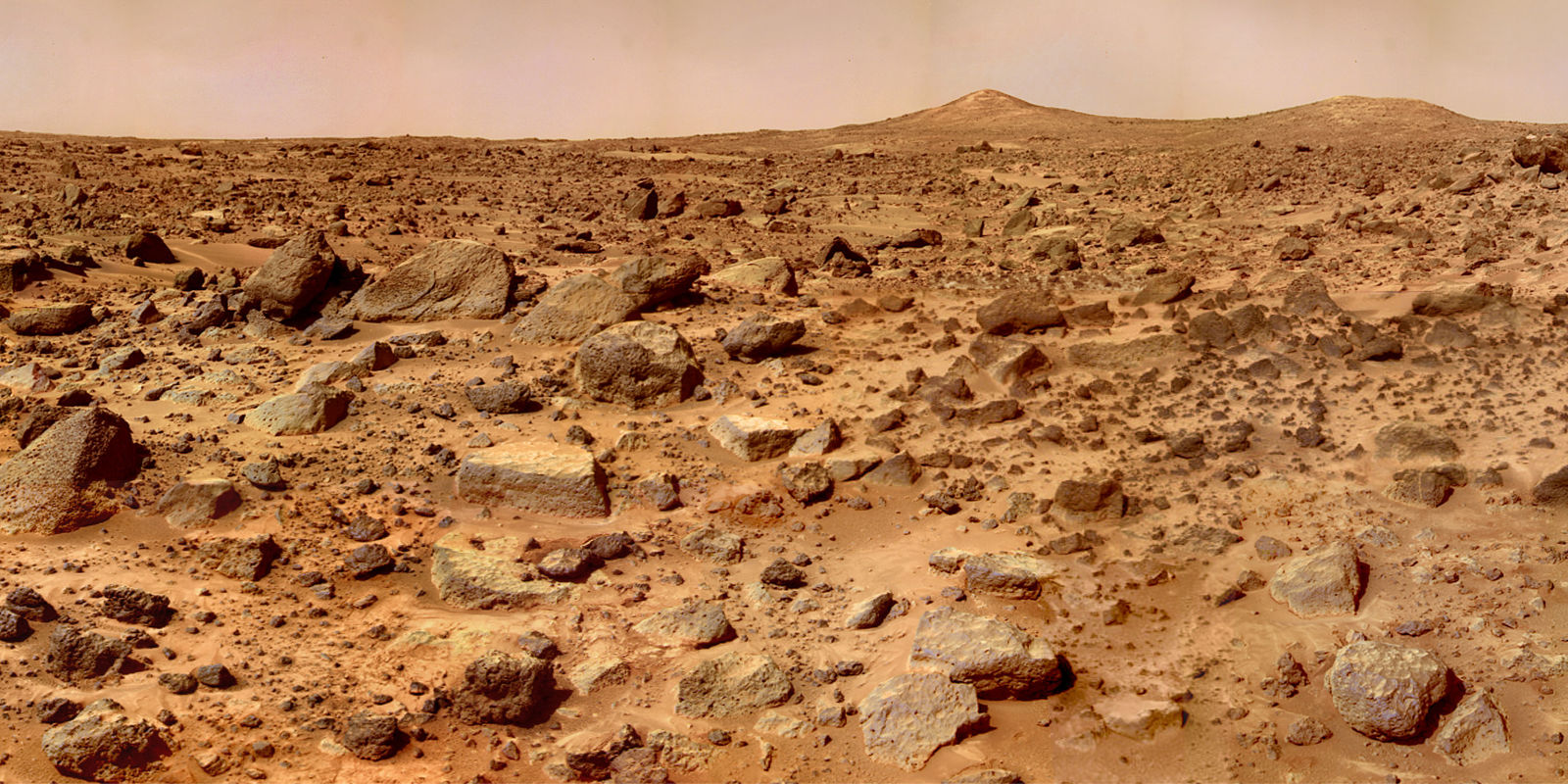
Blamey and his team also see their technique being used on Mars. Since you can also find salt crystals that contain air pockets there, we could learn a lot more about Mars’s ancient atmosphere. This could be done by equipping future Mars rovers with the device Blamey and his team made. Analysing the planet’s salt crystals could prove that Mars’ atmosphere contained a lot of oxygen in the distant past, which could help us with finding out if life ever arose on Mars, or if it was possible. This shows that one invention can teach us about both terrestrial and extra-terrestrial life. 

Click here to read more about chemistry.
Click here to read more about geograpgy.
Click here to read more about astronomy.

Sources:
http://pop.h-cdn.co/assets/16/07/1600x800/landscape-1455662627-mars-surface-web.jpg

Monday, 1 August 2016

A red window into Jupiter

Jupiter is way hotter than it should be. And the planet has the biggest storm in the solar system. James O’Donoghue and his team found a relation between these things.

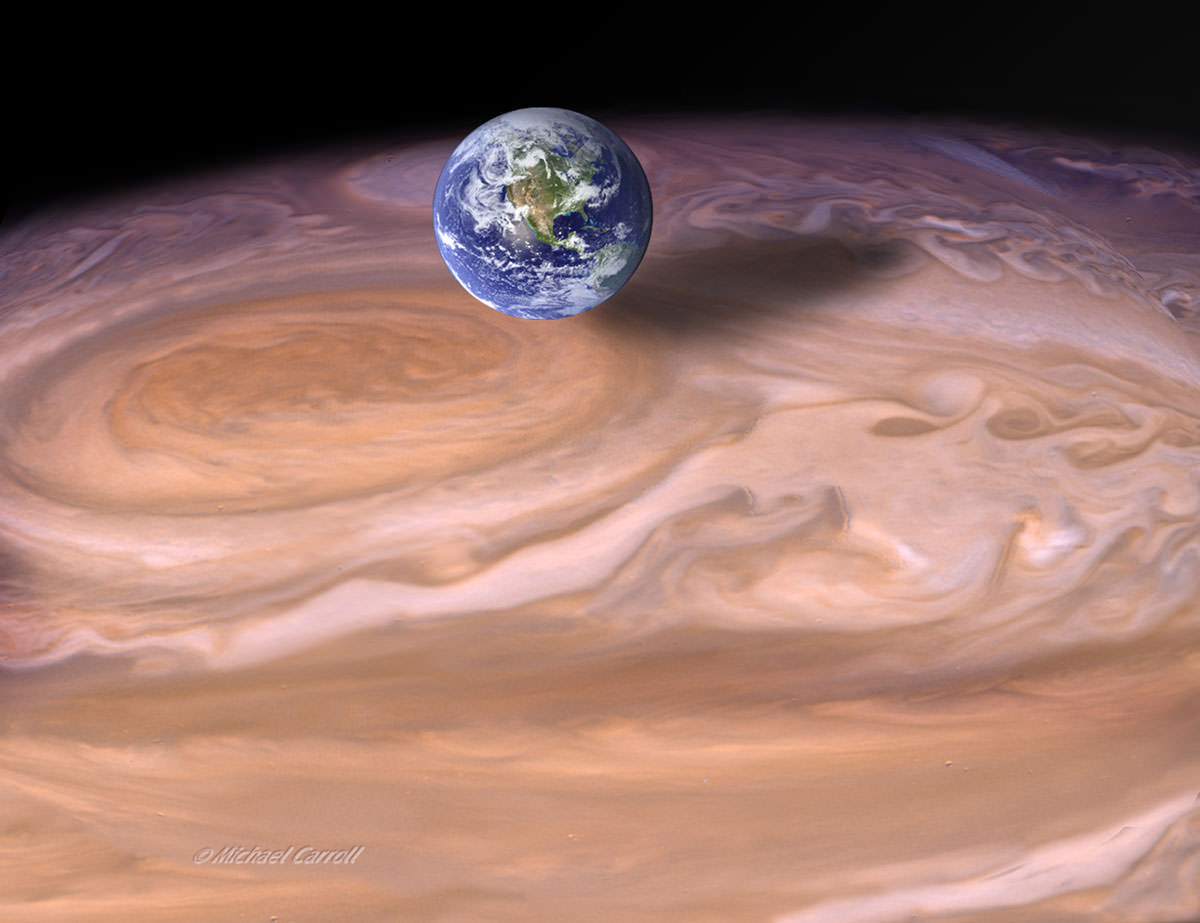
Earth compared to the Red Spot
An old pimple
This big storm is called the Great Red Spot, because it’s a big red spot. This spot is in fact a giant cyclone in Jupiter’s atmosphere. But it’s not just a normal cyclone, it’s an anticyclone, which means that it turns in the opposite direction of all the other gases in Jupiter’s atmosphere. This creates a rather pretty pattern on Jupiter. It’s so huge because Jupiter is a gas planet, so it has no rocky surface like earth does. There is therefore less friction and cyclone is not slowed, thus keeping its size. This is also the reason why the Great Red Spot has been around for so long. The spot has been around for at least 186 years, but Robert Hooke, a 17th century scientist, also claimed to have seen the spot 351 years ago. But now, the Great Red Spot also appears to do something else, and it’s pretty warm.

Where does that heat come from?
Scientists discovered a really weird thing about Jupiter. The planet is a couple of hundreds of degrees Celsius hotter than the planet is supposed to be if it was heated only by the sun. Scientists proposed to explain this by saying that Jupiter was heated up by its polar light, but computer models showed that the heat created by polar light would just stay around the poles, and not spread to lower latitudes. But now scientists have a new theory. The Great Red Spot is one of the hottest objects in Jupiter’s atmosphere. James O’Donoghue and his team measured temperatures above the Great Red Spot that were 370 degrees Celsius higher than the surrounding atmosphere. And now they think the Red Spot is actually giving us a little sneak peek into Jupiter’s lower atmosphere, which we cannot usually see due to the high number of thunderstorms taking place. O’Donoghue and his team now think that these thunderstorms can actually heat up the whole planet, and especially the lower regions of the atmosphere, to the point that it is way hotter than it’s supposed to be. 

All mixed up
The reason that there’s so much heat above the Great Red Spot, and not so much above other parts of Jupiter’s upper atmosphere, is that both layers of the atmosphere get mixed together by that giant storm, and with that their temperatures also mix. In the Red Spot, a lot of this heat ends up in the higher part of Jupiter’s atmosphere, and not just in the lower atmosphere. Meanwhile, in the rest of Jupiter’s atmosphere, the upper atmosphere is only heated from below, by the extremely hot lower atmosphere, and both layers don’t really get mixed. Because of this, the rest of Jupiter’s top layer isn’t as hot as the Red Spot, but still way hotter than the sun would make the planet. This shows how a huge spot can give us a huge insight into a huge planet. 

Click here if you want to read more about astronomy.

Sources:

Saturday, 9 July 2016

One planet dancing with three stars

Our planets circles just one star, but Kevin Wagner and his team have found a planet that orbits a whacking three stars! How have they found this planet? They just looked.

Spotting planets
Most of the time, exoplanets, planets that are outside of our solar system, are discovered with the transit method. This method uses the brightness of a star to determine if a planet moves in front of it, because if that happens, the star gets a little bit dimmer, and with that, scientists can find out the size, orbit time and other things about that exoplanet. Discovering an exoplanet through directly looking at it with a telescope is really hard. Because the light from the star is so much brighter than the light that comes from the planet, it’s hard to see the thing, particularly because it’s also very close to the star. So scientists use some smart tricks to block out the starlight, and they can observe the planet. With this particular exoplanet, it was even harder than normal to block out the starlight, since there wasn’t just one star, but three. But there’s also a large advantage of directly observing an exoplanet compared to using the transit method; when they directly look at it, scientists can find out what kind of atmosphere the planet has. And Kevin Wagner and his team have found out that this new exoplanet is a bit like Jupiter.

That’s an odd size
Planets like Jupiter aren’t very rare, in fact, it’s one of the most common types of exoplanets. And planets in star systems with more than one star aren’t that rare, but what makes this particular star system special is its size. This star system, which is called HD 131399, is way bigger than ours, which is quite weird, since planets usually don’t orbit that far away from the centre of a system with more than one star. This is because the gravity of ‘outer’ stars (B and C) make it impossible for a planet to form so close to those outer stars.

How did it end up there?
Kevin Wagner and his team have two theories about how the planet ended up in its orbit. One theory is that the planet used to orbit the centre star or the outer stars and was kicked out of orbit by another planet. Another states that the planet already existed before the three-star system formed and the planet accidentally ended up in its odd orbit when the three-star system came into existence. The problem with the first theory is that it requires another large planet to hang around in the star system, the planet that kicked our Jupiter-like planet out of orbit, and scientists haven’t found this planet yet. It could, however, be the case that we simply can’t detect this planet. But for now, this strange star-system remains a mystery. 

Click here to read more about astronomy.

Sources:

Thursday, 7 July 2016

Big asteroid created Fear and Panic

Mars has two moons; Phobos and Deimos. Now, Pascal Rosenblatt and his team think that the planet used to have way more moons, as they publish in this week’s Nature.

Fear and Panic; Phobos and Deimos
Scientists used to think that Phobos and Deimos, Mars’s moons, are two asteroids that got stuck in Mars’s gravity. This also made sense, since the asteroid belt is close to Mars. Moreover, the moons have an irregular shape and are not made of the same stuff as Mars. These are also clear signs that Phobos and Deimos originally were asteroids. There’s only one problem. When an asteroid gets caught in the gravity field of a planet, its orbit is usually elliptical, oval shaped. This is because the asteroid is shooting through a bit before being pulled back by the planet, this creates the oval shape. But, Phobos’s and Deimos’s orbits are circle shaped. And Mars’s gravity is way too weak to turn an oval orbit into a circular orbit. The chances that the circular orbits happened by accident are so small that it is more likely that Phobos and Deimos formed in another way, closer to Mars.

A big boom results in some moons
Pascal Rosenblatt and his team believe that Phobos and Deimos are formed out of debris that was formed when a giant asteroid hit Mars. That debris then formed a ring around Mars, and with computer simulations, Rosenblatt and his team found out that a couple of moons were formed out of that debris. All those moons, except two, orbited too close to Mars and crashed into the surface. The other two moons slowly moved into higher orbits and eventually became what we now know as Phobos and Deimos. We have, of course, no way to check this. Since we can’t just travel back in time and take a look. But if Phobos and Deimos are made out of a little bit of Mars and a bit of asteroid, it would pretty much prove this theory right.

The Borealis basin is the orange area on the left
Solving our puzzle
But there’s also another thing this new theory can explain. If an asteroid collided with Mars, there must be a crater. Rosenblatt and his team might even have found this crater already; the Borealis basin, a crater that covers around forty percent of the surface of Mars. The collision that created this crater must also have created a lot of debris, out of which the two moons and more could have easily formed. And at the same time, this new theory about Mars’s moons is another piece in the puzzle that is our solar system, and we might even be able to solve the complete puzzle one day.


Click here to read more about astronomy.
Click here to read more about physics.

Sources:

Sunday, 5 June 2016

Sneak peek into Jupiter

‘We use Earth-bound radio observations to peer beneath Jupiter’s surface.’ says Imke de Pater in this week’s issue of Science. With radio waves, she and her team managed to see what goes on under Jupiter’s surface.

Mixed signals
An ammonia molecule
The scientists were able to see as deep as a hundred kilometres beneath the surface. They have discovered lots of ammonia. The ammonia has confused scientists for quite a while. When spacecraft Galileo dropped a probe into Jupiter’s clouds in 1995, the probe already discovered really high concentrations of ammonia. This was quite strange, since the VLA radio telescope in New Mexico never managed to find such high concentrations of ammonia. This made scientists think that Jupiter’s atmosphere must consist of two layers; one with high concentrations of ammonia, and one with low. That were sometimes mixed up a bit by thunderstorms. Recent studies with an improved version of the VLA radio telescope show that there’s no need for two layers in the atmosphere, and that Galileo’s space probe just dived into a strange part of the atmosphere.

The radio wave picture (top one) shows
 the movements of ammonia in Jupiter’s atmosphere, 
the bottom picture is a normal picture taken by Hubble.
Simplifying the stripes
The new version of the VLA radio telescope has discovered stripes in Jupiter’s atmosphere, close to its equator. These stripes have alternating high and low concentrations of ammonia. And the high concentrations are caused by plumes of ammonia that rise from deeper inside Jupiter. This discovery enabled Imke de Pater and her team to fit both the high and low concentrations of ammonia into the same pattern. This pattern gives us a more detailed understanding of what’s going on around a hundred kilometres deep in Jupiter’s atmosphere. And also of the processes that happen much deeper in the atmosphere, since the patterns higher up are influenced by the processes lower in the atmosphere. Like when you see the fiftieth domino in a line of dominoes fall, you know that the first one also has fallen.

Husband and wife
This knowledge is also helpful for a new mission to Jupiter. Next month, space probe Juno is going to arrive by Jupiter. It is going to orbit around Jupiter and researching its gravity field, magnetic field and also concentrations of water and ammonia. With researching the water concentrations on Jupiter, scientist hope to find out more about Jupiter’s origin. And the new explanation of ammonia concentrations can be tested by Juno. This space probe can also peek deeper into Jupiter, because it’s way closer.

Click here if you want to read more about astronomy.

Sources:

Tuesday, 31 May 2016

Life explained by a comet

Kathrin Altwegg and her team have discovered the building blocks of life on a comet. This can be evidence for a theory about how life on earth arose.

A comet and his friend
One and a half year ago, space probe Philae landed on a comet. To be specific, comet 67P/Churyumov-Gerasimenko. This was the first time space engineers landed something on a comet. It wasn’t a perfect landing, however. The probe bounced of the comet a few times, because there isn’t much gravity to pull the lander down, since the comet is very small. Fortunately, the engineers managed to secure it, although the lander ended up just behind a mountain, making its solar panels practically useless, because of the shadow. This made sending data to earth very difficult for the probe. But after many struggles, it has made an interesting discovery.

The Lego blocks of life
Philae has found the building blocks of life in the tail of the comet. The lander has found amino acids, that make up proteins, like Lego blocks make up a Lego house, which are essential for life. But also phosphorus, which is a component of, among others, ATP, a chemical which is very important for managing the energy levels in your body. These building blocks alone don’t make life yet, of course. But these amino acids and phosphorus can tell us something about how life on earth arose.


Brought by comets
The panspermia theory is strongly supported by this discovery. This theory states that these building blocks of life were formed in space and after that become part of the nebula around the sun from which earth and the other planets were formed. Later, the amino acids, phosphorus and other chemicals would rain down on the planets, and delivering the building blocks to the planet. Since earth had a good environment for life, so one thing led to another, and life on earth arose. There is, however, no way to know for sure that this is the correct theory. There are many theories about how life arose, both scientific and religious. But this discovery really supports this the panspermia theory.


Click here to read more about biology.
Click here to read more about astronomy.

Sources: